


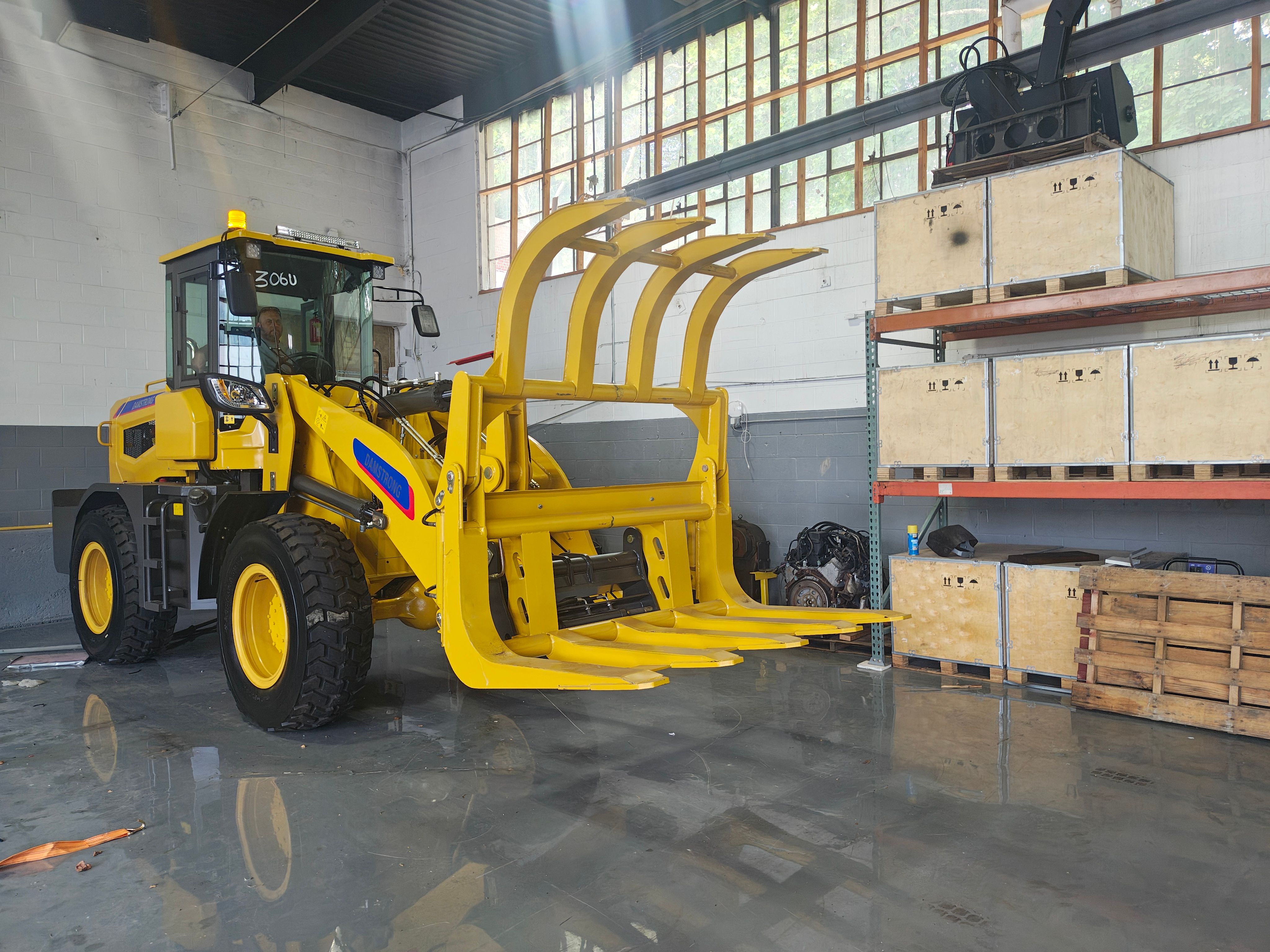
Wheel Loaders and Snow Pushers for Airport and Airfield Snow Removal
t
tj@civsav.com
tj@civsav.com
Clearing a commercial parking lot leaves room for error. A strip missed on the first pass gets cleaned up on the second. Equipment that goes down mid-shift gets swapped out while the lot waits. The consequences of an incomplete job are inconvenient. Nobody gets hurt because a corner of the lot has an inch of snow on it.
Airport runway and taxiway snow removal operates on an entirely different standard. A runway that is not cleared to specification before aircraft operations resume is a runway that cannot be used. The friction coefficient of the pavement surface has to meet defined standards before clearance is given. Coverage has to be complete, not approximate. And the equipment doing the work has to perform reliably through the entire clearing event without going down in the middle of an active airfield during flight operations.
Damstrong's compact wheel loaders and snow pusher attachments are used in airfield snow removal operations because the combination of machine capability, attachment quality, and operational reliability meets the standard that aviation requires. This article covers what makes airfield snow removal different, why the equipment selection matters more in this application than in general commercial snow removal, and how the Damstrong loader lineup fits the specific demands of airport operations.
What Makes Airfield Snow Removal Different From Commercial Operations
Surface Tolerance
Airport runway and taxiway pavement is precision-engineered infrastructure with specific friction and surface integrity requirements. Equipment that digs into the pavement surface, damages pavement markings, or leaves debris from worn or failed components on the active movement area creates a hazard that triggers immediate inspection and potential closure.
Snow pusher edge selection for airfield work is critical for this reason. A rubber edge that scrapes cleanly without contacting the pavement aggressively protects the surface while delivering effective snow removal. A steel edge on runway pavement without careful management can contact painted markings and surface features that need to remain intact for aircraft navigation.
The comparison between steel and rubber edge configurations and which application each serves is covered in the article on steel edge vs rubber edge and which one is right for your snow removal application. For airfield applications specifically, rubber edge configurations are the standard approach on paved runway and taxiway surfaces where surface protection is a regulatory and operational requirement.
Operational Continuity
Commercial snow removal can absorb equipment downtime with some reorganization. Airfield snow removal during active operations has no equivalent flexibility. A compact wheel loader that goes down on a taxiway during a clearing event creates both a logistics problem and a safety problem simultaneously. The machine is on an active airfield. It needs to be moved. Other equipment needs to continue working around it. And the clearing event that needed to be completed before aircraft resumed operations is now delayed.
Equipment reliability is not just a convenience in airfield snow removal. It is a safety requirement. Damstrong's machines are built in Connecticut and are backed by warranty coverage that reflects confidence in the reliability of the equipment leaving the manufacturing facility. For airfield operators evaluating equipment, the warranty terms and the manufacturer's support responsiveness are part of the operational reliability picture, not just the machine's initial specification.
Coverage Speed
Airports have defined time windows for snow removal operations. Runway closure during a snow event needs to be as short as possible for operational reasons and for the airport's relationship with airlines and passengers. The clearing operation needs to complete quickly, which means equipment productivity matters alongside surface protection and reliability.
A snow pusher sized correctly for the loader, running at the loader's optimal travel speed for the surface and snow conditions, covers ground faster than undersized equipment making more passes. The snow pusher sizing calculation that produces the right match for each loader model in the Damstrong lineup is covered in the article on what size snow pusher do you really need and how to match it to your loader. For airfield operations where coverage speed directly affects how quickly the airport can resume operations, getting this match right is worth the calculation.
Which Damstrong Loaders Serve Airfield Snow Removal Applications
LTS23 for Tight Airfield Access Areas
The LTS23 mini loader is Damstrong's most compact machine with a footprint that fits into the access-constrained areas of an airfield that larger equipment cannot navigate efficiently. Taxiway connector areas, aircraft apron corners, gate area paving, and the complex geometry of terminal building approaches all benefit from a machine that can maneuver in tight quarters without requiring wide turning clearances.
The LTS23 is not the high-production machine for clearing long runway stretches. It is the machine that cleans up the areas the larger machines cannot reach cleanly, that gets into corners and transitions where a 930 or 936 requires an extra pass to complete, and that keeps the total airfield clearing operation moving without leaving pockets of uncleared surface that need a separate pass.
930 and 930 HD for General Airfield Clearing
The 930 and 930 HD are the production machines for airfield snow removal applications that require consistent coverage across taxiways, aprons, and runway connector areas. The 930's combination of maneuverability and pushing capacity handles the clearing passes that make up the majority of the airfield's surface area efficiently.
The 930 HD adds structural capacity for the heaviest snow conditions and the applications where the standard 930's capacity is at the edge of what the job requires. For northern airports that experience heavy wet snowfall or repeated accumulation events through a single storm, the HD's additional capacity provides the margin that keeps production rates up when conditions are most demanding.
936 and 938 for High-Volume Airfield Applications
Larger airfields with extensive paved surface areas, multiple runways, and high operational tempo during snow events use the 936 and 938 for their combination of pushing capacity and travel speed. These machines cover ground faster and move more snow per pass than the 930-series, which reduces the total clearing time on large airfield footprints where coverage speed directly determines when the field can reopen.
Snow Pusher Configuration for Airfield Operations
The snow pusher attachment on an airfield loader needs to meet the same reliability and surface-protection standards as the loader itself. A snow pusher that loses a cutting edge on an active runway, that drops hardware on the taxiway, or that fails structurally during a high-production clearing event creates the same airfield safety concern as a loader mechanical failure.
Edge Management
Rubber edge wear on airfield snow pushers needs to be monitored and the edge replaced before it wears through to the metal backer. An edge that is worn to the point where the metal backer is contacting the pavement is no longer protecting the surface. Edge inspection as part of the between-shift maintenance check catches this before it becomes a pavement or surface marking damage situation.
How to maintain snow pusher attachments through a full season of heavy use, including edge inspection intervals and the maintenance discipline that extends attachment service life, is covered in the article on how to maintain your snow pusher for long-term use.
Trip Edge Configuration
Snow pushers with trip edge design allow the leading edge to deflect backward when it contacts a raised surface feature, a pavement joint, or a hidden object rather than transmitting the full impact through the loader's hydraulic system and the operator. On airfield paving with expansion joints, utility access covers, and the edge transitions between paved areas, a trip edge configuration protects both the attachment and the loader from the repeated impact loads that a rigid edge design would transfer.
Width Selection for Airfield Geometry
The width of the snow pusher determines how many passes are required to cover the taxiway or apron area being cleared. A pusher that is too narrow for the pavement width leaves strips that require an additional pass. A pusher that is wider than the loader can effectively push in heavy snow conditions bogs the machine and reduces travel speed. Matching the pusher width to both the loader's capacity and the pavement geometry being cleared is the configuration decision that produces the best clearing rate for each specific airfield area.
Year-Round Loader Utilization at Airports
The winter investment in a compact wheel loader for airfield snow removal produces a machine that does not need to sit idle when the snow season ends. The same loader that cleared the apron and taxiway connector areas in January can handle material movement, ground support equipment positioning, airside construction support, and the year-round facility maintenance tasks that an active airport generates.
An airport that has already made the investment in a Damstrong compact loader for snow removal has a machine that can continue generating utility through the operating season rather than sitting in storage from April through November. The year-round return on a loader investment and how the right attachments extend the machine's productive season is covered in the article on loader attachments that add value year-round and keep your machine working every season.
Let's discuss how we can help transform your business with our innovative solutions. Our team is ready to assist you with your unique needs.
Follow us
© 2025 Civilized Savage